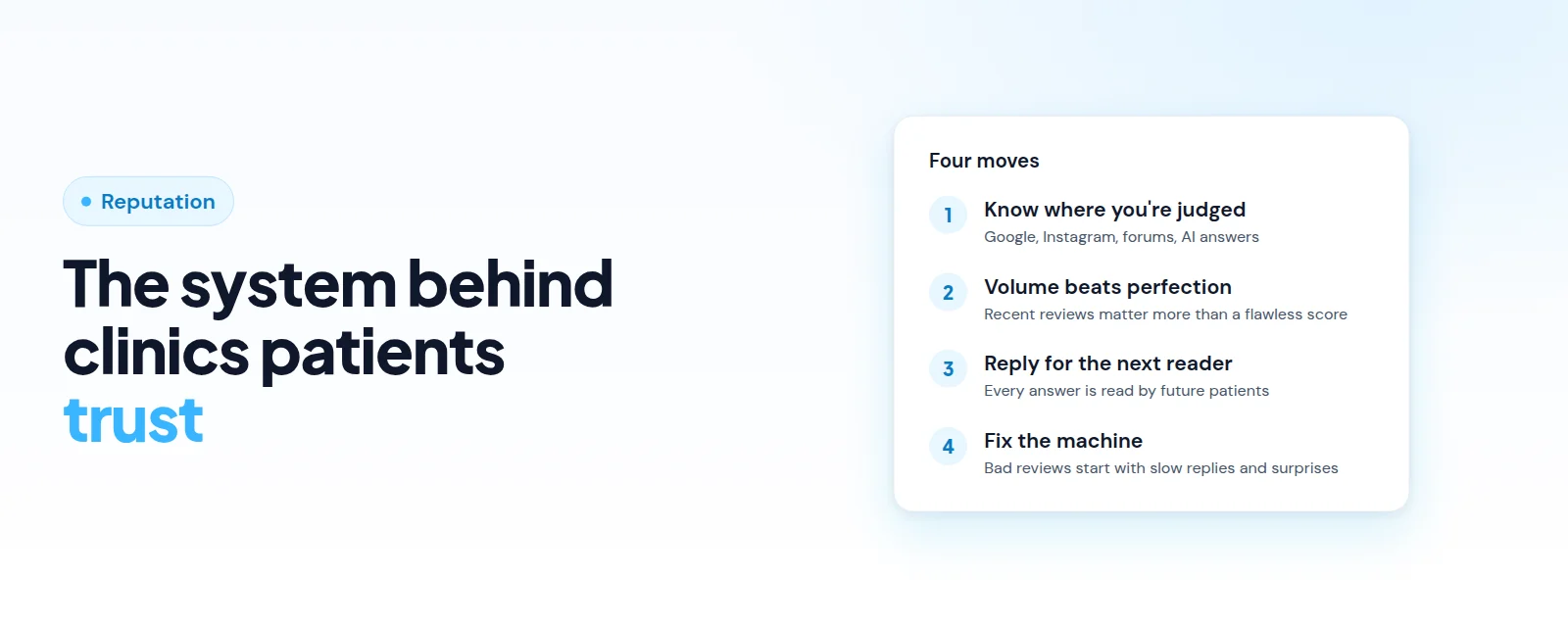
Dentist reputation management gets sold as a dark art — monitoring dashboards, review-gating software, "suppression" services. For a clinic, it's simpler and harder than that: your reputation is the sum of what patients say where future patients look, and the only sustainable way to manage it is to operate in a way that produces good things to say, then make saying them effortless.
Here's the working system, in the order that matters.
1. Know where you're actually being judged
For a local clinic, the shortlist is short: Google reviews (the profile that appears next to your map pin), then whatever your market uses — Trustpilot in the UK and northern Europe, WhatClinic and RealSelf for treatment shoppers, Facebook recommendations in some markets. For dental tourism clinics, add the country-comparison layer: patients ask Google and now AI assistants "best dental clinic in Istanbul / Tijuana / Budapest" — and the answer is assembled largely from review volume, review recency, and how consistently your clinic is described across the web.
The audit takes an hour: search your clinic the way a patient would, in their language, and write down what page one actually shows. That list is your battlefield. Everything else is noise.
2. Volume and recency beat perfection
A 4.6 rating across 400 recent reviews outperforms a 5.0 across 30 old ones — for humans and for ranking algorithms. Which means the core of reputation management isn't responding to the rare bad review; it's industrializing the ask:
- Ask every happy patient, on departure day (or at treatment completion), while gratitude is at its peak.
- Ask in the channel you already share — for most international clinics that's the WhatsApp thread. A direct Google-review link pasted into a warm conversation converts at multiples of an email sent next week.
- Make it a pipeline step, not a memory task. If your CRM tracks the case to completion, "review requested" belongs on the checklist the coordinator works through, the same as "aftercare instructions sent". The treatment coordinator playbook covers where this fits in the cadence.
One warning: never gate ("only ask happy patients after surveying them privately"). Google's policies prohibit it, platforms detect the statistical fingerprint, and a suspiciously perfect profile reads as fake to the patients you most want.
3. Respond like the next patient is reading — because they are
Review responses aren't for the reviewer; they're for the hundreds of prospects who read them later.
- Positive reviews: short, warm, specific ("So glad the All-on-4 journey went smoothly — enjoy the new smile, and we'll see you for the check-up"). Never copy-paste the same sentence down the page.
- Negative reviews: respond fast, stay clinical-calm, never argue medical details in public (and never confirm someone was a patient — confidentiality applies even when they've said it themselves). Acknowledge, state that you'd like to resolve it directly, and move the conversation to a real channel. A composed response under a harsh review often does more for trust than ten five-star ratings.
- Fake or policy-violating reviews: flag them through the platform's process and document everything, but keep expectations realistic — removal is slow and uncertain, which is one more reason volume is your real defense.
4. Fix the machine that generates the bad reviews
Most negative reviews in dental clinics aren't about clinical outcomes. They're about communication: nobody replied for three days, the price changed without explanation, the patient felt lost between visits. That's operational, and it's fixable — same-day responses in the patient's language via a shared WhatsApp inbox, transparent plan pages with itemized prices, and a follow-up cadence that means no patient ever feels forgotten. Reputation management that ignores operations is just apology-writing at scale.
5. The reputation flywheel, measured
Track three numbers monthly: review count and average on your primary profile, review-request-to-review conversion (are coordinators actually asking?), and mentions in AI answers for your key queries. When review requests are a pipeline step in a CRM that tracks cases to completion, the first two numbers stop being luck and start being output.
Keep going: the communication habits that prevent bad reviews live in the WhatsApp CRM guide, the trust mechanics of winning international patients in dental tourism marketing, and the follow-up discipline behind both in speed to lead.