Dental tourism marketing is a different sport from local dental marketing. Your patient has never driven past your clinic, can't ask a neighbor about you, and is being courted by four other clinics in three other countries while they talk to you. Everything that builds trust locally — the building, the front desk, word of mouth — has to be rebuilt digitally, in the patient's language, over a phone screen.
Here's the playbook that works, assembled from what high-performing international clinics actually do.
The funnel, honestly
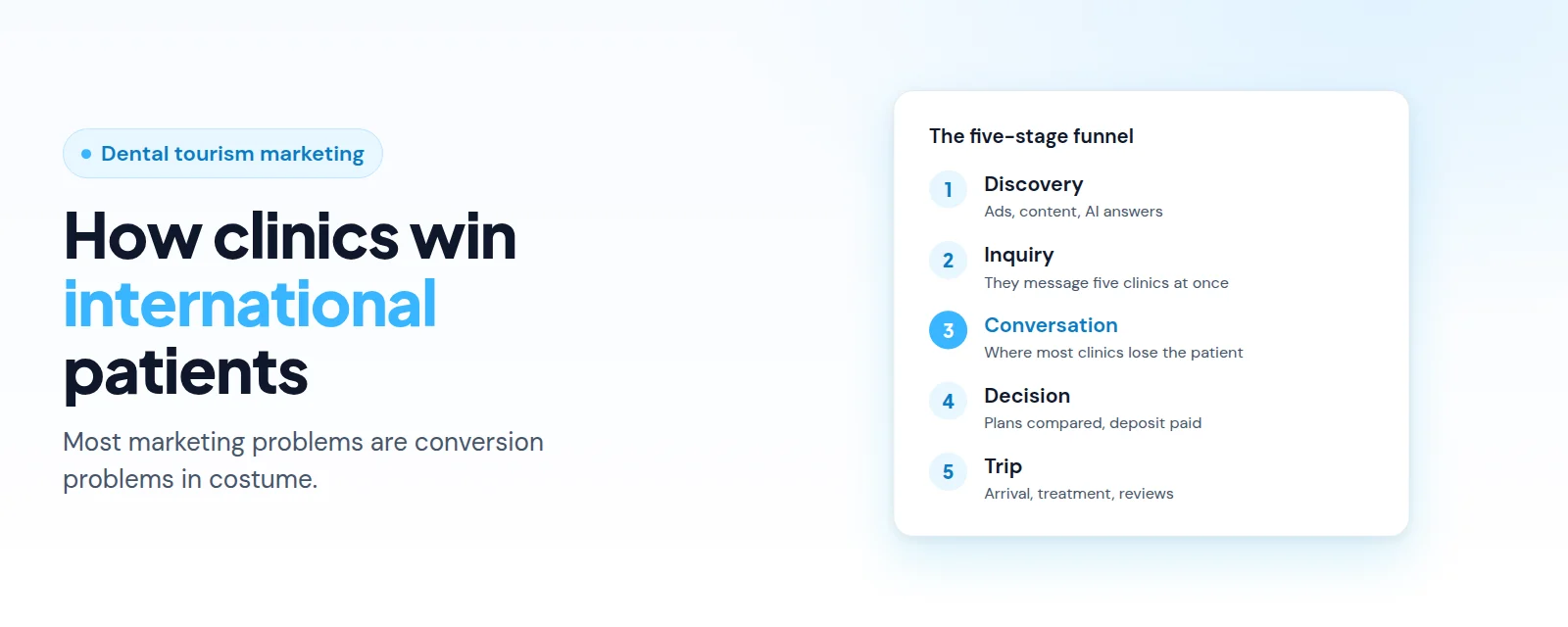
A dental tourism patient moves through five stages, and clinics lose most of their money at stage three:
- Discovery — they see your ad or content on Instagram, TikTok, Google, or inside an AI chat answer.
- Inquiry — they message five clinics at once. This is a shopping spree, not a commitment.
- Conversation — the stage that decides everything. Speed, language, and credibility here determine who gets to present a plan at all. Most clinics lose here and blame their ads.
- Decision — plans compared, family consulted, deposit paid.
- Trip — logistics, arrival, treatment, and the reviews and referrals that feed stage one.
Marketing spend multiplies whatever your stage-3 machine can convert. That's why the highest-ROI "marketing" investments are usually answering within five minutes and a trained treatment coordinator — before a single extra dollar of ads.
Channels, ranked by how clinics actually win
1. Meta (Instagram + Facebook). Still the volume engine — visual, targetable by source country, and where your audience already spends its evenings. Run lead ads with qualifying questions, one campaign per source market, in that market's language. The full setup is in our Facebook ads guide.
2. Organic social proof. Patient-journey stories, day-in-the-clinic reels, staff faces. This content rarely goes viral; that's not its job. Its job is to survive the "is this place real?" background check every inquirer performs before sending a deposit to a foreign clinic.
3. Google — search and Maps. International intent queries ("veneers in Turkey", "all-on-4 abroad") are competitive but convert at high rates; your Google Business Profile with hundreds of reviews is often the deciding trust artifact. Reviews are a system, not luck: ask every happy patient on departure day, in the WhatsApp thread you already share.
4. AI assistants — the new front door. Patients now ask ChatGPT to shortlist clinics abroad. Whether you appear depends on machine-readable content: real pages describing who you treat, transparent pricing context, and consistent structured information. It's early, it's growing, and almost no clinic is doing it deliberately.
5. Agencies and facilitators. They bring volume with commission and less control over the patient relationship. Reasonable as a supplement; dangerous as the whole strategy — you're building someone else's asset.
The three trust accelerators
- Reply in the patient's language, always. A German patient who gets a warm German reply within minutes has, statistically, already half-chosen you. AI-assisted drafting makes this feasible for a small team on WhatsApp.
- Show prices in context. Clinics hiding all pricing lose the comparison-shopping stage silently. You don't need a public menu — you need fast, credible, personalized quotes with options, delivered as a professional plan page rather than a number in a chat bubble.
- Make the logistics visible. Airport pickup, hotel, translator, aftercare — spelled out before the patient asks. The unspoken question behind every dental tourism inquiry is "will I be taken care of, alone, abroad?" The clinic that answers it first, wins.
Measure it like a business, not a channel
Cost per lead flatters bad campaigns. Track the chain — leads → conversations → plans presented → accepted → deposits → arrivals — per channel and per source country, in a CRM built for this funnel. Two numbers deserve a weekly look: cost per arrival by channel (kills vanity campaigns) and conversation-to-plan rate (exposes the stage-3 machine). Clinics that measure this way typically discover a channel they should double and one they should shut off — within the first month.
The uncomfortable summary
Most "dental tourism marketing" problems are conversion problems wearing a marketing costume. Before increasing spend, verify: leads reach a human within five minutes, in their language; every consult produces a same-day plan; every open plan has a scheduled follow-up; every accepted plan has a deposit path. When those are true, marketing spend finally buys what it's supposed to buy — patients, not spreadsheets of names.