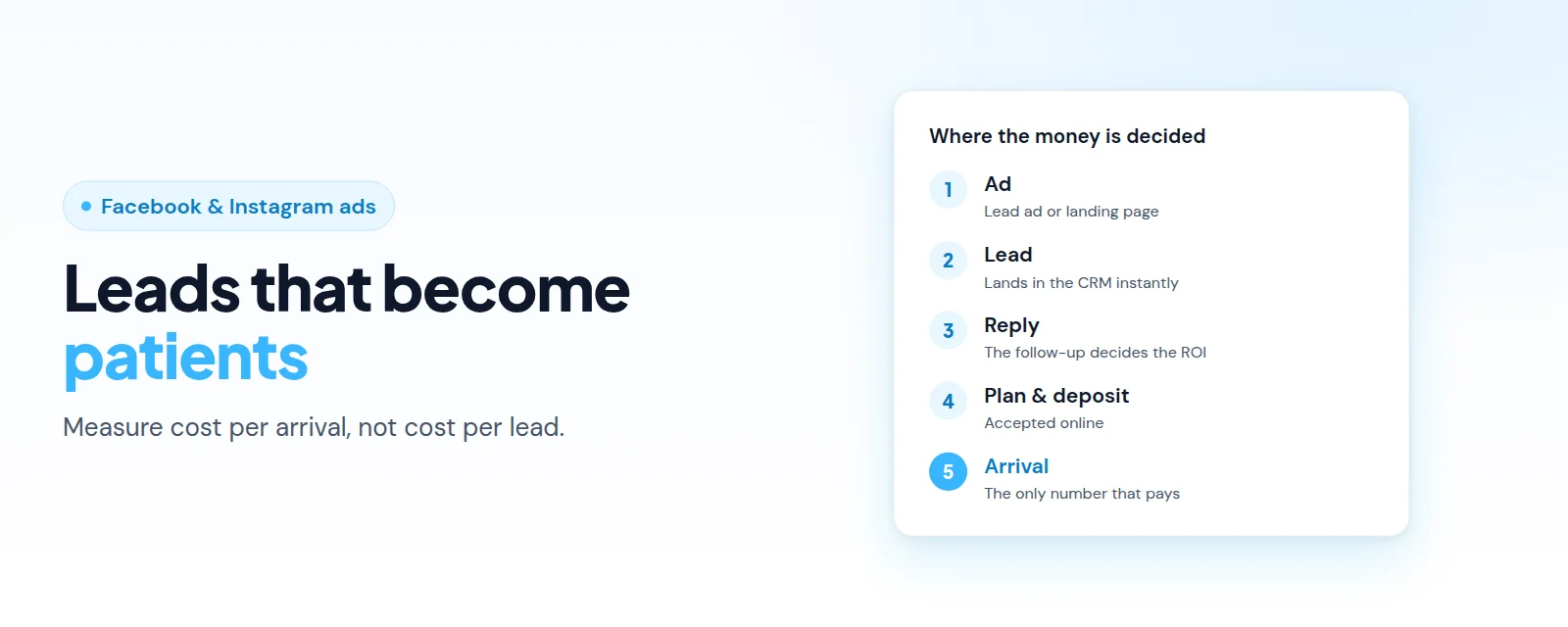
Facebook and Instagram ads are the highest-volume patient acquisition channel most dental clinics will ever run — and the most commonly wasted. The waste almost never happens inside Ads Manager. It happens in the thirty minutes after the lead arrives.
This guide covers what actually determines results, in order of importance.
1. The follow-up decides the ROI, not the ad
Run the math clinics skip: if leads cost $15 and you close 1 in 40 because forms sit in a CSV until Friday, your patient acquisition cost is $600. Answer the same leads within five minutes with a real qualification question and close 1 in 15, and the same ads produce patients at $225. Nothing you change in creative or targeting moves results as much as speed to lead.
Practical minimum: leads flow by webhook into a CRM the moment the form is submitted, get auto-assigned to a coordinator, and trigger a push notification. If your current process involves downloading a leads file — fix that before spending another dollar.
2. Lead ads vs. landing pages
- Meta Lead Ads (in-app forms) — lower friction, cheaper leads, lower intent. Best default for dental tourism: the audience is scrolling, not researching, and every extra tap loses half of them.
- Landing page + form — more friction, more expensive, higher intent. Use once you have volume and want quality, or for high-consideration treatments.
Start with lead ads, but make the form do real work: add 2–3 qualifying questions (Which treatment are you interested in? When are you planning treatment? — and for tourism, Which country are you contacting us from?). Each question raises cost-per-lead slightly and raises lead quality a lot. A cheap unqualified lead is the most expensive thing you can buy.
3. Creative that works (and stays compliant)
- Real beats produced. A dentist speaking to camera, a patient walking through the clinic, an honest treatment-journey story — these outperform polished agency video in this vertical, consistently.
- Be careful with before/after images. Meta's personal-health ad policies restrict creative that implies guaranteed outcomes or targets perceived flaws ("hate your smile?"). Frame around the positive experience and the service, not the viewer's defects — accounts get restricted over this regularly, and a banned ad account is an existential problem for a clinic that lives on this channel.
- Speak one language per ad set. A German-language ad for German-speaking patients, with a form and follow-up in German, beats an English catch-all — and tells you which market actually converts.
4. Targeting in 2026: mostly broad, geo matters most
Detailed interest targeting has shrunk (health categories especially). What works now: broad targeting + strong creative + the right geography, and letting Meta's delivery optimize against your form completions. For dental tourism, geography is the strategy — run separate campaigns per source market (UK, Germany, France, Gulf states…) so budgets, languages, and results stay separable. Lookalikes built from your converted patients (not raw leads) are the one audience worth maintaining — which requires your CRM to know which leads became patients.
5. Measure cost per arrival, not cost per lead
Cost-per-lead is the vanity metric of dental advertising. A campaign with $9 leads that never book loses to a campaign with $30 leads that fly in. That means attribution has to survive the whole journey: ad → lead → conversation → accepted plan → deposit → arrival. When your CRM tracks source through to deposit, the weekly question changes from "which ad is cheapest?" to "which ad pays for surgeries?" — a question worth real budget decisions.
Benchmarks vary by market, but a healthy dental-tourism funnel from Meta traffic looks roughly like: 100 leads → 60 reached → 25 plans sent → 8–12 accepted → 5–8 arrivals. If your numbers collapse between "leads" and "reached," the problem is follow-up, not ads.
6. The five most common mistakes
- Exporting leads instead of webhooks (see point 1 — it's most of the money).
- One catch-all campaign for every country and language.
- Forms with zero qualifying questions, then blaming lead quality.
- Judging campaigns on cost-per-lead in week one instead of cost-per-arrival in week eight.
- No follow-up cadence — the treatment coordinator playbook exists because ad spend without it is a donation to Meta.
The short version
Ads bring attention; systems convert it. Get instant lead capture, same-language follow-up on WhatsApp, qualification questions in the form, and cost-per-arrival measurement in place — then scale spend with confidence, because every extra lead lands in a machine that converts it.