Case acceptance rate is the percentage of presented treatment plans that patients actually say yes to:
Case acceptance = accepted plans ÷ presented plans × 100
Most clinics don't know their number. The ones that measure it usually find it's lower than they guessed — and that it moves fast once you treat plan presentation as a sales process instead of a formality.
Why patients really say "let me think about it"
It's rarely the price itself. It's:
- Price shock without context. A single five-figure number, delivered cold, with nothing to compare it against.
- Confusion. The patient doesn't fully understand what's being fixed, why, or what happens if they wait. Confused people never buy — they stall.
- No urgency. Nothing in the presentation says why now; thinking about it forever feels safe.
- Not enough trust yet. Especially in dental tourism, where the patient is being asked to fly to a clinic they found on Instagram.
- The plan is hard to share. Big cases are family decisions. A blurry PDF or a number quoted in chat gives the patient nothing convincing to show a spouse.
Every tactic below attacks one of those.
Nine ways to raise case acceptance
1. Present options, not a verdict. One plan invites yes/no — and "no" is safer. Two or three options (say, Standard and Premium) change the question from "should I do this?" to "which one suits me?" Patients who choose feel in control; patients given a verdict feel sold to.
2. Anchor the price. Show the premium option first or alongside. A $6,500 plan next to a $9,800 plan reads as reasonable; alone it reads as expensive. If you offer a package discount, show the un-discounted subtotal — visibly saving money is part of the experience.
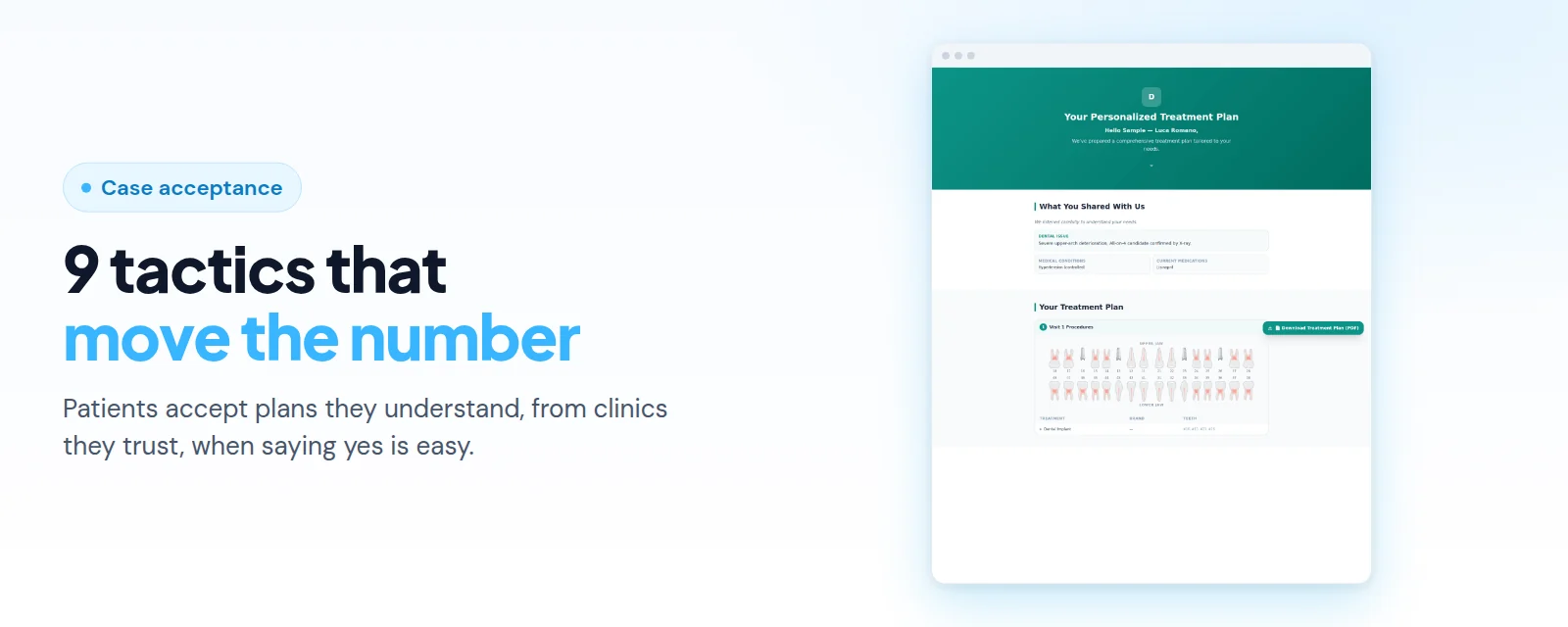
3. Show, don't tell. A tooth chart the patient can see — these teeth, this condition, this fix — does more than three paragraphs of clinical text. People accept what they understand.
4. Send the plan the same day. Every day between consultation and plan is a day of cooling interest and competitor shopping. Same-day plans are one of the strongest acceptance predictors we see. (This is a workflow problem, not a dentist problem — plan-building software turns a diagnosis into a priced plan in minutes.)
5. Send a plan page, not a PDF. A personal, branded page — in the patient's language, on your domain, with the chart, the options, prices, before/afters, and an Accept button — is shareable with family, readable on a phone, and tells you when it's been opened. A PDF attachment is where cases go to die quietly.
6. Follow up like you mean it. Most acceptances happen after the second or third touch. Run a real cadence (day 1, 3, 7, 14) with something new each time — an answered objection, a similar case, a logistics detail. The treatment coordinator playbook covers the scripts.
7. Make the yes small. "Accept the plan and secure your dates with a deposit" is an easier commitment than "agree to $8,000 of surgery." Deposits convert intention into a booking — and patients who've paid something show up.
8. Answer the unasked questions in the plan itself. Guarantee terms, what's included, how travel works, what happens if something needs adjusting. Objections you answer preemptively never become reasons to stall.
9. Measure it per coordinator, per option count, per source. Acceptance rate by rep exposes coaching needs; by option count proves (usually) that multi-option plans win; by lead source shows which marketing brings patients who actually convert. Your CRM should give you all three without a spreadsheet.
What good looks like
Benchmarks vary wildly by treatment mix and market, but as rough guidance for international clinics: under 25% acceptance on presented plans means presentation or follow-up is broken; 35–50% is solid; above that, your coordinators deserve a raise. The trend matters more than the absolute — measure weekly, change one thing at a time.
The one-sentence version
Patients accept plans they understand, from clinics they trust, when saying yes is easy — multi-option, visual, same-day, followed up. Price is rarely the real objection; it's just the easiest one to say out loud.