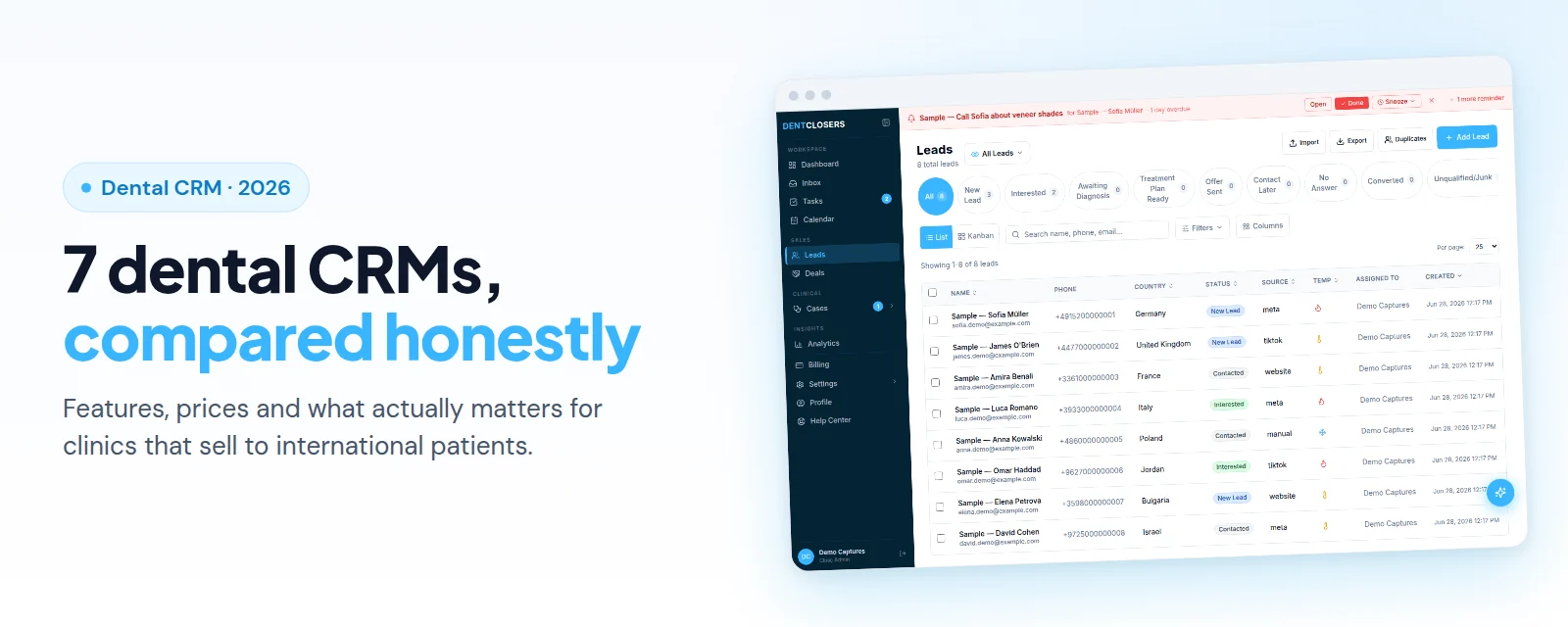
Searching "dental CRM" returns a wall of software companies each claiming the crown — including us. So let's do this differently. First, what a dental CRM actually is, how it differs from your practice management software, which features matter and what it costs. Then an honest comparison of seven options clinics actually shortlist, including where each one genuinely beats DentClosers.
Written by the DentClosers team. Competitor features were checked against each vendor's public documentation in October 2026. Plans and editions change, so confirm current details before you buy.
What is a dental CRM?
A dental CRM (customer relationship management system) is the software a dental practice uses to turn enquiries into booked, paying patients. It records every lead — from Facebook and Instagram ads, Google, your website form, WhatsApp or the phone — follows each one through a pipeline (new, contacted, consultation booked, treatment plan sent, accepted), and makes sure somebody follows up on time.
In plain terms: your practice management software looks after patients once they are in the chair. A dental CRM looks after them before — the part where most practices lose revenue, because a lead who isn't answered within minutes books with the practice that answered first.
Dental CRM vs. practice management software
The two get confused because some practice management systems include patient reminders. They solve different problems:
| Dental CRM | Practice management software (PMS) | |
|---|---|---|
| Main job | Win new patients and sell treatment | Run the clinic day to day |
| Who uses it | Treatment coordinator, front desk, sales | Dentists, hygienists, front desk, billing |
| Core records | Leads, conversations, pipeline, plans, follow-ups | Clinical charts, appointments, insurance, billing |
| Key moment | First reply to a new enquiry; plan acceptance | Appointment, treatment delivery, claim |
| Examples | DentClosers, Zoho or HubSpot set up for dental | Dentrix, Open Dental, CareStack |
Most growing practices run both: the PMS for clinical work, the CRM for everything that happens before the patient commits.
Features a dental CRM must have
A checklist to take into any demo:
- Automatic lead capture from Meta (Facebook/Instagram) lead ads, TikTok, website forms and webhooks — no CSV exports.
- WhatsApp, SMS and email in one shared inbox, linked to the patient record, so any team member can pick up a conversation.
- A pipeline with follow-up tasks, so nobody depends on memory to call a lead back.
- Treatment plans with prices and options the patient can read on their phone and accept.
- A tooth chart (odontogram) so the plan is built tooth by tooth, not typed as free text.
- Roles and data scope: each coordinator sees their own leads; the owner sees everything.
- Reporting on response time, consultations booked, plans accepted and revenue.
- Easy migration from the spreadsheet or CRM you use today.
What does a dental CRM cost?
Most CRMs charge per user per month, and the price climbs as you add automation or messaging. When comparing quotes, check three lines that are often extra: WhatsApp messaging, the number of users, and onboarding or data migration.
For reference, DentClosers costs $59 per user per month on Standard ($49 per user per month billed yearly) and $79 per user per month on Professional ($65 billed yearly), which includes the WhatsApp team inbox. See current pricing. There is a free trial with no credit card.
How to judge a dental CRM
Before the list, the four questions that matter more than any feature grid:
- Where do your leads come from? If the answer is Meta and TikTok ads, native webhook capture is non-negotiable — a CRM that ingests leads by CSV export is a leaky bucket with extra steps.
- Where do conversations happen? For clinics selling to international patients, that's WhatsApp. A CRM that treats WhatsApp as "someone's phone" leaves your pipeline outside the system.
- Who works in it every day? The treatment coordinator, not the owner. If the daily screen doesn't tell them who to call next, adoption dies in week two.
- Do you sell treatment plans? Then the plan — priced options, presentation, acceptance — should live in the same system as the lead, or you'll stitch tools together forever.
The seven options
1. DentClosers — built for clinics that sell treatment, especially to international patients
Our product, the DentClosers dental CRM, so judge the claims yourself on a free trial. What it does that generic CRMs don't: native Meta/TikTok lead capture, the clinic's own WhatsApp number in a shared team inbox, tooth-chart diagnosis, multi-option treatment plans patients accept online, travel logistics for fly-in patients, and a coordinator workspace with an enforced follow-up cadence. Interface in seven languages, including English, Spanish, Turkish and Arabic.
Where it's not for you: DentClosers is deliberately not a practice management system — no clinical records, no insurance claims, no chair scheduling. A small local practice that mostly needs appointment reminders will find lighter tools cheaper.
2. Zoho CRM — the flexible generalist
Endlessly customizable and inexpensive, with a huge app ecosystem. Clinics bend it into shape with custom modules — and that's exactly the trap: you become the integrator. Zoho does offer a built-in WhatsApp Business integration, but chats attach to generic contact records, there is no dental object model (teeth, plans, visits), and coordinators end up keeping the real pipeline in chat anyway. We wrote a detailed Zoho/Bitrix comparison from clinics that migrated.
Choose Zoho if you have an admin who loves configuring CRMs and your sales process isn't dental-specific.
3. Bitrix24 — the everything platform
CRM, tasks, sites, telephony, chat — a lot of software for the money, popular in Turkey and Eastern Europe. The dental workflow still has to be faked with pipelines and custom fields, and the interface overwhelms non-technical coordinators. Lead capture from Meta works through connectors; WhatsApp through paid add-ons.
Choose Bitrix24 if you want one platform for a large back office and can invest in setup.
4. Dentrix / practice management suites
Dentrix, Open Dental, CareStack and similar PMS products excel at what DentClosers doesn't do: clinical records, charting for treatment delivery, insurance, scheduling. Their CRM/marketing layers, though, are built for recall and reminders — not for chasing a Meta lead within five minutes or negotiating an All-on-4 case over WhatsApp in three languages. Many clinics run a PMS and a sales CRM side by side; that's the setup we designed for.
Choose a PMS-first stack if your bottleneck is clinical operations, not lead conversion.
5. GoHighLevel — the agency machine
If a marketing agency runs your ads, they may already manage you in GoHighLevel: funnels, SMS/email automation, unified inbox. It's powerful and white-labeled, but it's the agency's system, not yours — and dental specifics (tooth charts, priced plans, travel) don't exist. DentClosers syncs with GoHighLevel, so clinics often keep the agency funnel and own the patient pipeline themselves.
Choose GHL if your agency operates your entire funnel and you're comfortable with that dependency.
6. Pipedrive / HubSpot — the clean sales CRMs
Excellent pipeline UX (Pipedrive) and a huge free tier (HubSpot). For a clinic they share the same gaps: WhatsApp is available only on paid tiers or through add-ons, and as a generic channel (HubSpot connects it to its conversations inbox on paid Hubs), no dental objects, per-seat prices that climb fast on HubSpot once you need automation. Fine for a clinic whose sale is simple and phone/email-based.
Choose them if your patients are local, your sale is one visit, and WhatsApp isn't the channel.
7. Spreadsheets + WhatsApp — the honest baseline
Free, familiar, and where most clinics start. The cost shows up later as silence: nobody knows who wasn't called, follow-up depends on memory, and when a coordinator leaves, the pipeline leaves in their pocket. If that's the pain you recognize, read why clinics lose so many of their leads — it's the problem every tool on this list exists to solve.
The short version
| You are | Best fit |
|---|---|
| Dental tourism / international patient clinic selling plans on WhatsApp | DentClosers |
| Clinic with a CRM-savvy admin and generic sales needs | Zoho |
| Large back office wanting one platform for everything | Bitrix24 |
| Clinic whose bottleneck is clinical ops and insurance | Dentrix / PMS |
| Agency-run marketing you're happy to stay inside | GoHighLevel |
| Local clinic, simple one-visit sale, no WhatsApp | Pipedrive / HubSpot |
Whatever you pick: measure speed to lead in week one. The tool matters less than answering first.
Frequently asked questions
Do I need a dental CRM if I already have Dentrix or Open Dental? Usually, yes, if you get leads from ads or messaging. Practice management software is built for patients who are already booked; it doesn't capture ad leads, run a sales pipeline or remind your coordinator who to call back today. The two work side by side.
What is the difference between a dental CRM and a generic CRM like HubSpot or Zoho? A generic CRM tracks "deals" and "contacts". A dental CRM knows about teeth, treatment plans, visits and (for fly-in patients) travel. With a generic CRM you build those pieces yourself with custom fields and integrations.
Can a dental CRM capture Facebook and Instagram leads automatically? A good one should. In DentClosers, Meta lead ads arrive in the pipeline within seconds through Meta's own integration, with no Zapier step and no CSV export.
How long does it take to switch? Most of the work is moving your existing leads. DentClosers imports spreadsheets and can migrate from Zoho or Bitrix24 with an AI-assisted import, so a clinic can usually start working in the new system on day one.
Who should own the CRM in a dental practice? The treatment coordinator or front-desk lead who answers new enquiries. The owner or practice manager should check the reports weekly: response time, consultations booked and plans accepted.